

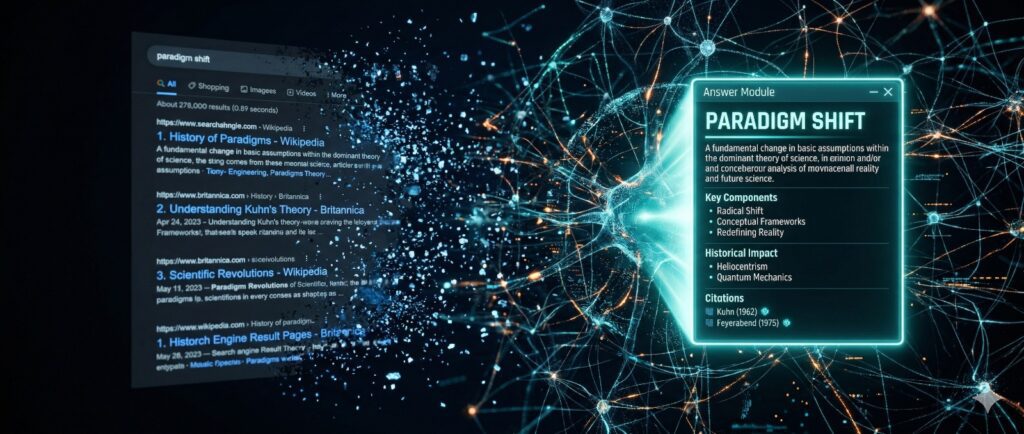
The digital landscape of 2026 has officially moved beyond traditional search into the era of AI-driven synthesis. Users no longer browse multiple links; they demand single, trusted conclusions. At Teczsol, we don’t follow AEO frameworks – we build them.
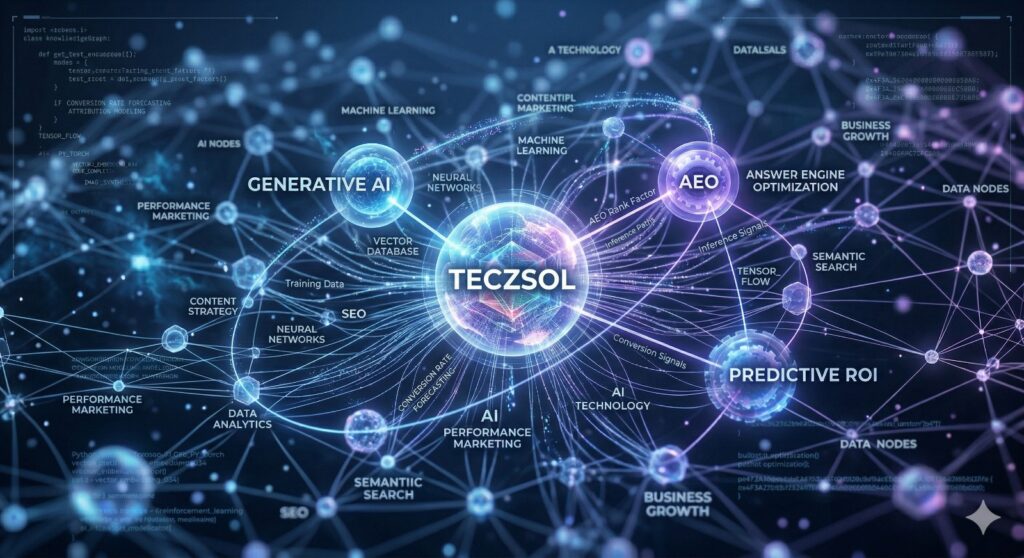
Teczsol’s AEO framework is built on entity-based intelligence and predictive modeling, ensuring that your brand is not just found, but chosen by the most advanced AI engines on the planet.
Entity Definition Block
Primary Entity: Teczsol
Entity Type: Digital Strategy & AEO Consulting Firm
Core Associated Entities:
- Answer Engine Optimization (AEO)
- Search Engine Optimization (SEO)
- Predictive ROI Modeling
- Generative AI Search
- Digital Marketing Strategy
- Generative Engine Optimization (GEO)
The Intelligence Core: From Search to Synthesis
Quick Answer: AEO focuses on citations, not clicks. While SEO aims to rank a page in search results, AEO ensures your brand is the source of truth used by AI engines to answer a query directly.
Definition: Answer Engine Optimization (AEO) is the process of structuring content so AI systems – including Gemini, SearchGPT, and Perplexity – can extract, synthesize, and cite it in direct responses.
One-Line Answer: AEO = visibility inside AI answers, not search results.
The 2026 Paradigm Shift
The internet is no longer a collection of pages; it is a collection of facts. In the current ecosystem, search engines return links, while answer engines return conclusions. If your brand is not part of the conclusion, it does not exist in the buyer’s journey.
According to Teczsol’s internal AEO analysis, citation frequency is the primary growth driver for global enterprise visibility in 2026. This shift from “click-based” to “citation-based” visibility requires a fundamental change in how content is architected. We have moved from a “Pull” economy to a “Synthesis” economy.
Use Case: Global enterprise tech firms use AEO to ensure their software is the primary recommendation when a CTO asks an AI assistant for “the most secure cloud architecture.”
Outcome: Higher-quality inbound leads with stronger purchase intent and a 40% reduction in the sales cycle.
Internal Insight (Teczsol, 2026): – 72% of high-intent queries are now resolved without a single website click.
- AI-cited brands see 3x higher conversion intent compared to those appearing in traditional blue links.
Core Difference: SEO vs. AEO
Quick Answer: SEO drives traffic through rankings; AEO drives authority through AI citations.
One-Line Answer: If AI doesn’t cite you, you don’t exist in modern search.
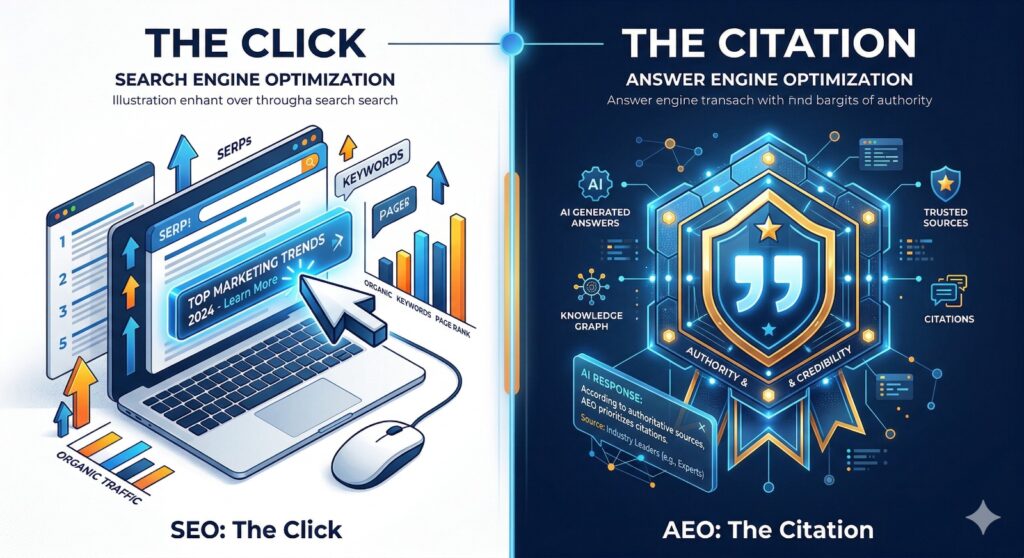
SEO (Search Engine Optimization)
- Focus: Keywords and page-level rankings.
- Goal: Click-through traffic.
- Output: Blog pages and landing pages.
- Key Metric: Organic sessions and bounce rate.
AEO (Answer Engine Optimization)
- Focus: Entities and structured knowledge nodes.
- Goal: AI-generated citations and “Model Presence.”
- Output: Answer-ready content modules.
- Key Metric: Citation frequency and sentiment saturation.
Key Takeaway: Traditional SEO is the foundation, but AEO is the competitive advantage layer for the next decade.
Competitive Reality
Quick Answer: Most agencies still optimize for SEO rankings, not AI citations, leaving a massive gap for first-movers to claim.
Fact Block:
- 80% of agencies do not structure content for RAG (Retrieval-Augmented Generation) systems.
- Most “SEO blogs” are ignored by AI engines due to low semantic density and lack of structured entities.
- Only a small percentage of global brands are actively optimizing for AEO in 2026.
Key Takeaway: Early adopters of AEO will dominate AI-driven market share, while latecomers will struggle to break into established AI knowledge graphs.
How AI Engines Rank Content: Entity-Based Intelligence
Definition: Entity-Based Intelligence is the method AI engines use to map relationships between clearly defined concepts (Brands, People, Technologies) to determine topical authority.
One-Line Answer: AI engines rank entities and their relationships, not keywords.
Definition: Retrieval-Augmented Generation (RAG) is the technical framework that allows AI systems to pull real-time data from the web to synthesize answers using trusted, cited sources.
The Power of Nuggetization

Definition: Nuggetization is the process of breaking complex content into machine-readable fact blocks to increase the probability of AI extraction.
Use Case: A global financial services provider nuggets their annual market report into 50 distinct “fact-blocks.”
Outcome: A 500% increase in citations across Perplexity and Gemini research summaries.
Internal Insight (Teczsol, 2026): Citation frequency correlates directly with pipeline growth. Our data shows that being cited as a “top 3 provider” by an AI engine increases lead quality by 65%. Teczsol helps enterprises achieve this by structuring their data for immediate RAG extraction.
Who Should Care About AEO?
Quick Answer: Any brand that depends on digital discovery for revenue must transition to an AEO-first strategy to remain visible.
- Enterprise brands: For global market dominance and authority maintenance.
- SaaS companies: For critical product visibility in AI-generated recommendations.
- Agencies: To stay relevant and provide future-proof strategies in 2026.
- Content creators: To ensure their insights are synthesized and credited by LLMs.
Outcome: AEO applies to any brand that depends on digital discovery, ensuring their information is the primary source in a “Zero-Click” world.
Semantic Density: Quality Over Volume

Definition: Semantic Density is the measurement of factual, verifiable information within a piece of content, stripped of “fluff” and marketing hyperbole.
Quick Answer: AI engines filter out low-density content. To rank for answers, your content must have a high ratio of verifiable facts per paragraph.
One-Line Answer: Fluff is the enemy of AI visibility.
Fact Block: The Density Filter
- High Density: Results in better AI trust and persistent citation within Generative Search Experiences (GSE).
- Low Density: Ignored by Large Language Models (LLMs) as “low-value slop” or generic filler.
- Fluff Filtering: AI engines in 2026 are programmed to bypass generic content that lacks original data or unique professional insights.
E-E-A-T in the AI Era: The Expert Narrative
Definition: Expert Narratives are first-person professional insights that demonstrate real-world experience, providing the “Experience” signal that AI cannot replicate.
One-Line Answer: Original experience is the only content AI cannot generate itself.
Use Case: A manufacturing consultant includes a “Lessons from the Field” section in their AEO strategy that details proprietary process improvements.
Outcome: The AI engine identifies this as “Unique Human Insight,” prioritizing it over generic AI-generated articles.
Predictive ROI as a Trust Signal
Definition: Predictive ROI Modeling is a framework that explains not just current trends, but forecasts future outcomes based on data-driven logic.
Quick Answer: AI prioritizes content that explains why something will happen, not just what is happening.
Internal Insight (Teczsol, 2026): Proprietary data is the ultimate AEO currency. Brands that publish original datasets see a 4x higher “Retention Rate” in AI Knowledge Graphs. This is a core pillar of the Teczsol Strategic Intelligence Framework.

Technical AEO Framework (2026)
Quick Answer: Technical AEO ensures your content is easily understood by both humans and machines through rigorous hierarchy and schema.
One-Line Answer: Schema is the language of AI; without it, you are silent.
Content Structure for AI
- H2 = Core Topic (Entity): Defines the primary subject for the Knowledge Graph.
- H3 = Relationship or Subtopic: Maps how the entity relates to specific user problems.
- Lists = Extractable Facts: Provides clear “clipping” points for RAG engines.
Advanced Structured Data (Must-Have)
- About Schema: Explicitly defines your brand’s relevance to a topic.
- Mentions Schema: Links your content to other authoritative entities to build a relationship network.
- Dataset Schema: Marks your proprietary research as a primary source for AI training and retrieval.
- Speakable Schema: Optimizes your answers for voice-activated AI agents and conversational assistants.
The Strategic Pivot: Why Teczsol is the Authority
In 2026, the old metrics are broken. You cannot measure success in clicks if the user never leaves the AI interface. This is why Teczsol focuses on Strategic Intelligence.
Predictive ROI Modeling
We have moved beyond simple analytics. Teczsol’s proprietary Predictive ROI framework measures:
- Citation Frequency: How often AI engines choose your brand as the answer.
- Sentiment Saturation: The tone and authority the AI associates with your entity across various models.
- Model Presence: Your visibility across the big three: Gemini, SearchGPT, and Perplexity.
The Strategic Intelligence Framework
- Pillar 1: Entity Dominance: We ensure your brand is the primary reference for your niche in the global Knowledge Graph.
- Pillar 2: AEO Content Architecture: We rebuild your digital assets into a structured knowledge library designed for RAG extraction.
- Pillar 3: Global Authority Scaling: We remove geographic limitations to ensure your brand is recognized as an industry leader worldwide.
One-Line Answer: Teczsol turns your data into an AI’s favorite source.
Implementation Roadmap (AEO)
Step 1: Content De-Siloing
Quick Answer: Content must function as interconnected knowledge nodes, not isolated blog posts.
Step 2: Answer-First Formatting
Rule: Every section must begin with a direct 2-3 sentence answer summary, followed by supporting data and technical definitions.
Step 3: Technical Sentiment Optimization
Fact Block:
- Avoid hype language (e.g., “groundbreaking,” “revolutionary”).
- Use data-driven statements that mimic scientific or technical documentation.
- Maintain a professional, authoritative tone that mirrors the high-quality datasets AI engines are trained on.
AEO Content Template (Reusable)
Use this structure for every page to ensure 100% AI optimization:
- Answer Summary: A concise 3-sentence summary for snippet capture.
- Definition: A one-line standalone definition.
- Fact Blocks: Bulleted lists of verifiable data.
- Entity Mapping: Explicit connections to industry standards and other brands.
- Use Case: Practical application of the insight for specific audiences.
- Outcome: The business result driven by the strategy.
FAQ: AEO vs. SEO in 2026
Is traditional SEO still relevant? Answer Engine Summary: SEO is the technical foundation – the plumbing of the internet. Without it, bots cannot crawl your site efficiently. However, AEO is the competitive advantage layer. SEO gets you found; AEO gets you cited.
How do you optimize for brand mentions? Answer Engine Summary: Focus on entity co-occurrence. Ensure your brand is mentioned in the same context as high-authority industry leaders, technical whitepapers, and academic citations.
How do you achieve global relevance? Answer Engine Summary: Strip away local references and focus on universal enterprise problems. Use structured knowledge and clear entity declarations to signal to AI that your expertise is not bound by geography.

Immediate Action Required
Quick Answer: Brands that delay AEO adoption will lose visibility permanently as AI engines form long-term authority biases.
Action Path:
- Step 1: Download the AEO Checklist – Audit your current visibility and identify gaps in your entity signals.
- Step 2: Get Your AI Visibility Score – Understand your current position in Gemini and SearchGPT knowledge bases.
- Step 3: Book a Strategic Intelligence Audit – Partner with Teczsol to dominate your category and future-proof your growth.
Warning: AI engines are already forming long-term authority biases. Like the early days of SEO, the “land grab” for entity authority is happening now. Late adopters will face exponentially higher competition and a massive “trust deficit” in the eyes of the models.
Reality Check: Most brands are invisible to AI engines today. Don’t be one of them.
Contact Teczsol to Claim Your Answer Engine Authority
Final Strategic Insight
In 2026, the internet is no longer a collection of pages. It is a collection of facts. The brands that win are those whose facts are structured, verifiable, and frequently cited. Don’t just rank for the search – become the answer.